AI for Public Interest
Context and Mission
I led product design for X4Impact, an intelligence marketplace connecting nonprofits, tech companies, and foundations. The idea began with Dr. Ying Li’s work on Domain Specific Knowledge Graphs[1] and evolved into one of the largest directories of tech‑for‑good products in the US. The core mission: build a shared data layer for social impact so these sectors can finally see and act on the same reality.
The final X4Impact platform
The problem
Foundations, nonprofits, and tech providers all depend on each other, but they operate in silos: - Foundations want to fund solutions that are actually in use, but lack visibility into which tools nonprofits adopt. - Nonprofits are overwhelmed by a noisy landscape of tech products, with little guidance on what works for organizations like theirs. - Tech companies want to deeply understand social problems and funding patterns, but data is fragmented across reports, research papers, and public datasets. Everyone is making high‑stakes decisions with incomplete information. Our challenge was to turn scattered data points into something people across sectors could actually search, explore, and act on.
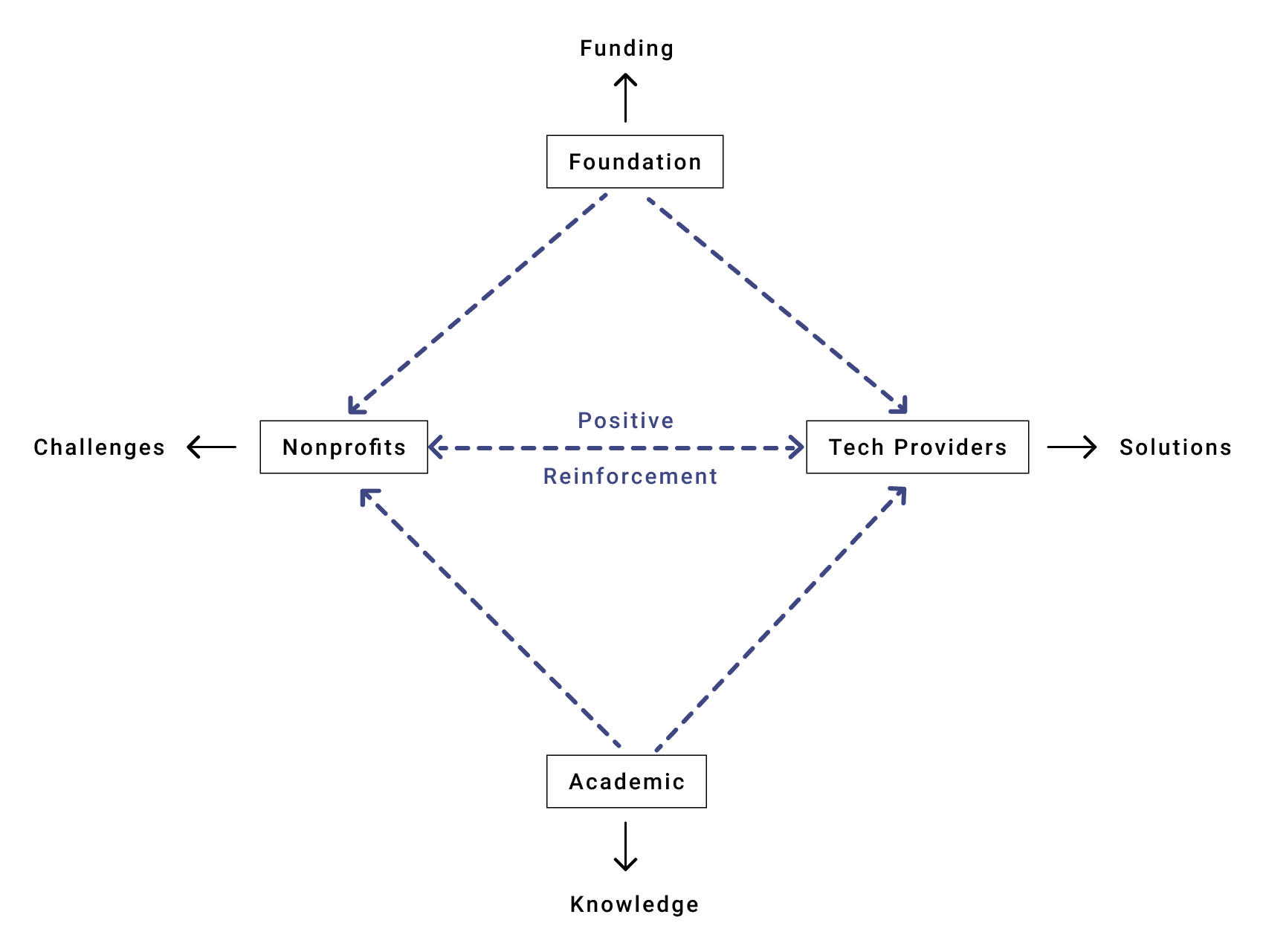
Four sectors that depend on each other but rarely share the same view of reality
My role and approach
As the lead designer, I owned end‑to‑end product design: framing the problem, defining the information architecture, prototyping new search and creation flows, and aligning a cross‑functional team around the most important use cases. To ground the work, we interviewed over 15 nonprofits, 15+ tech entrepreneurs, and 10 foundations. A few themes surfaced quickly:
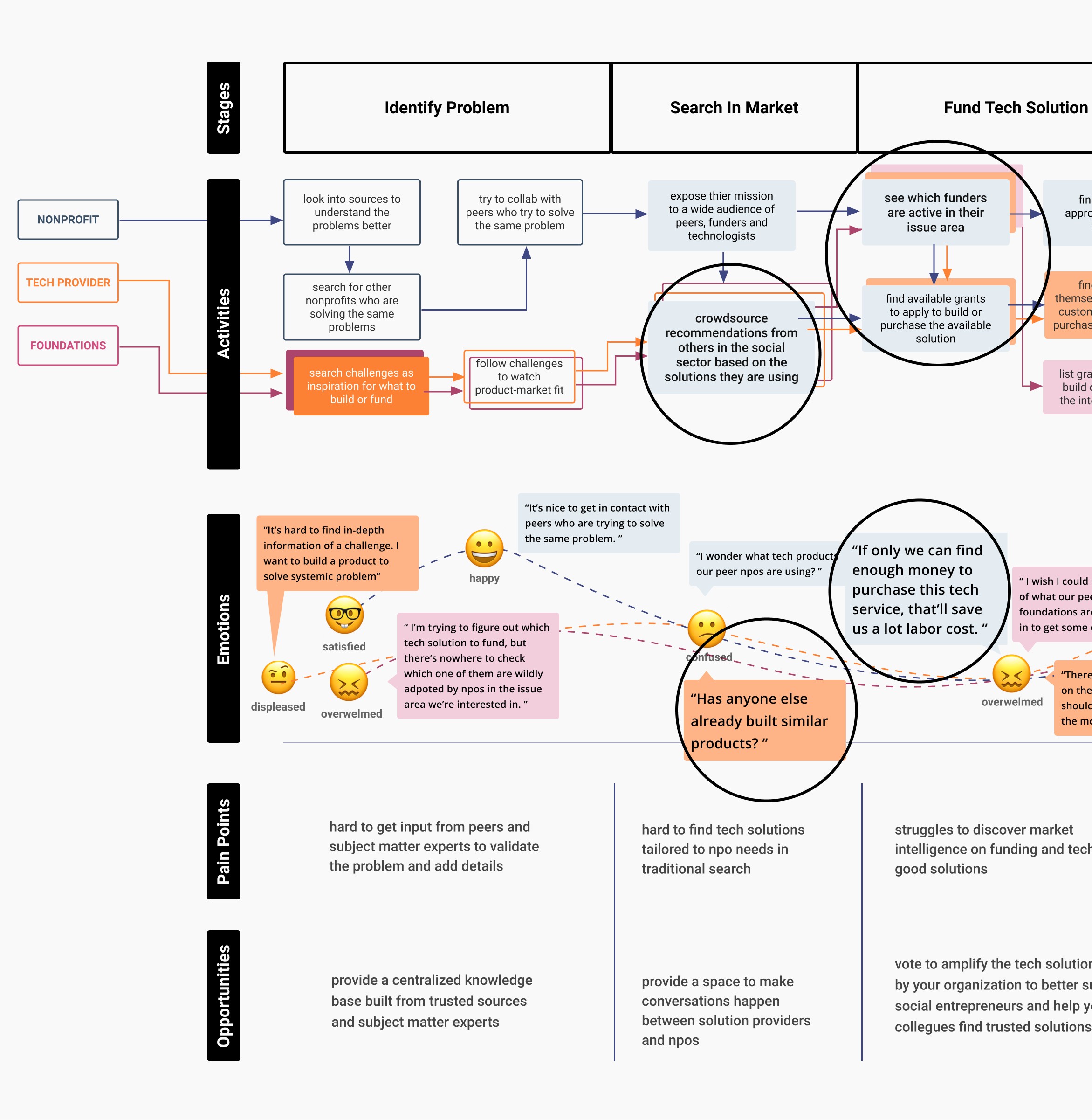
A journey map capturing how each group moves from identifying a problem to funding a solution
- People weren’t just “looking for answers.” Many were browsing to get inspired, to see what others were doing, and to discover adjacent opportunities. - Trust was fragile. Users were wary of self‑promotional content and needed quick signals of credibility. - Creating high‑quality challenges or solutions was a heavy lift, especially for busy nonprofit staff.
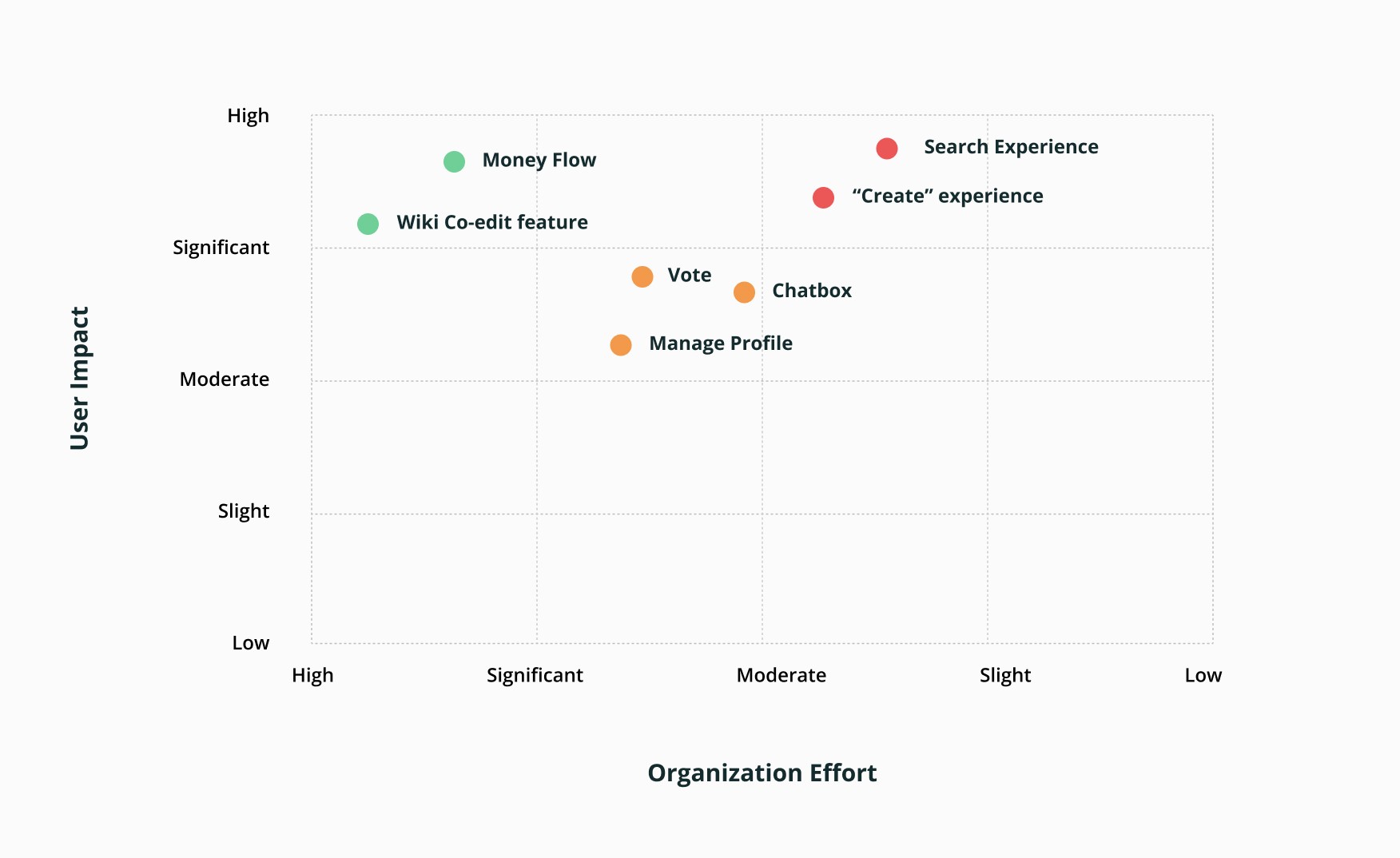
Mapping features by user impact vs. organizational effort
These insights shaped the key flows: search and discovery, content creation, and funding visibility.
Designing for discovery: from search box to “inspiration engine”
My first assumption was that users would arrive with a specific question and want a fast, direct answer. I designed a simple, prominent search bar to minimize noise and push people into search quickly.
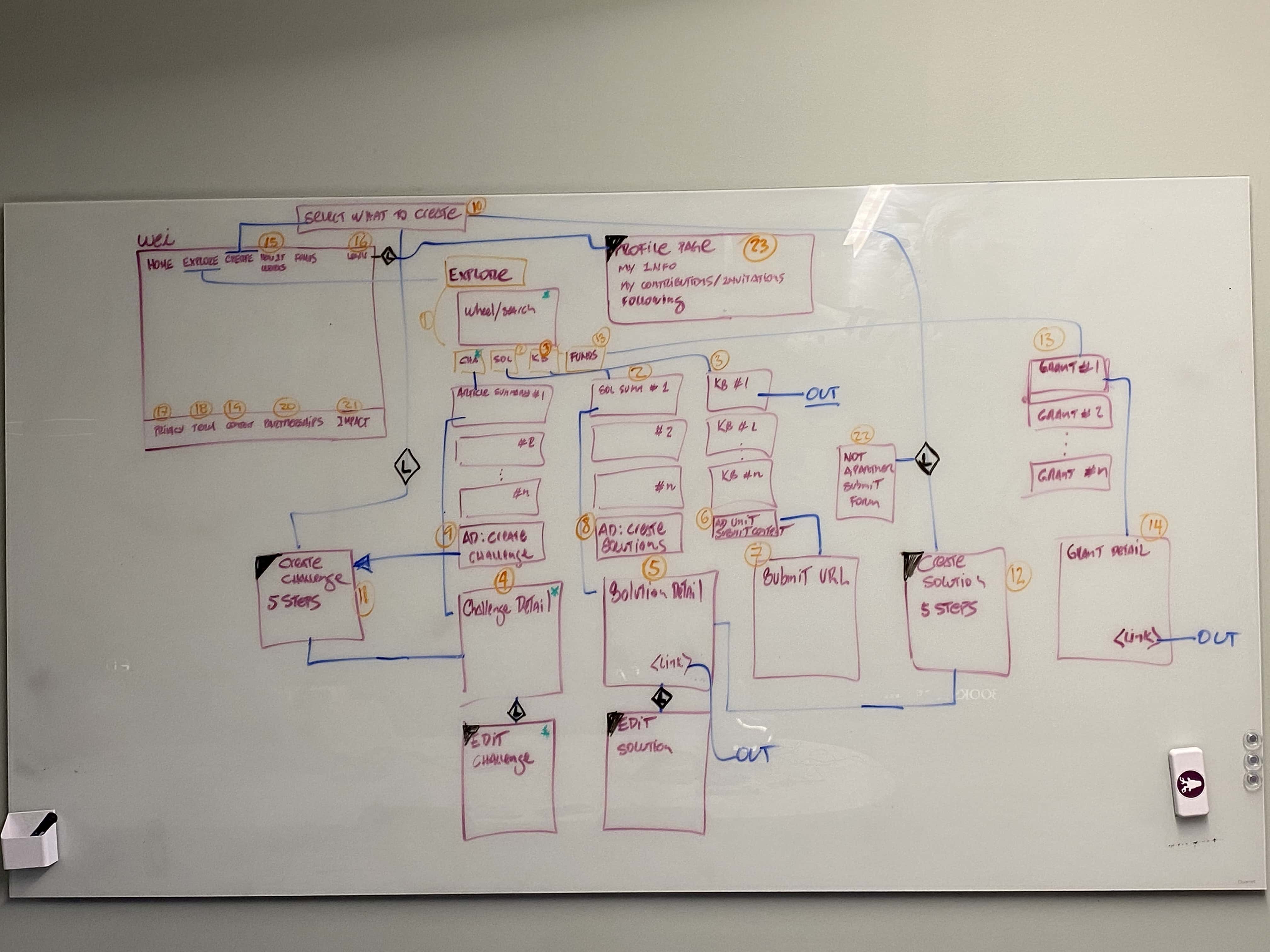
An early site structure built around the assumption that users have a clear question
Usability tests proved that assumption wrong. Many users didn’t have a precise query. Instead, they wanted to explore: “What’s happening around mental health and homelessness?” or “How are others using AI in education?” The experience needed to support wandering with purpose, not just targeted lookup.
Scoped search built to support users who are exploring, not just querying
To support this: - I mapped a more editorial, directory‑style structure that let people browse by theme, population, and issue area. - I explored scoped search patterns that combined free‑text search with structured filters so users could narrow down thousands of results without feeling lost.
Making complex filters human: the UN SDG “lucky wheel”
Across interviews, one common language kept showing up: the UN Sustainable Development Goals (SDGs). Foundations, nonprofits, and tech companies all used SDG labels as shorthand for issue areas.
Instead of presenting SDGs as yet another dense list, I experimented with a more playful, visual pattern: a “lucky wheel” of SDGs, using color and icons to make scanning and selection faster. - The wheel became a way to scope search results by SDG with a single interaction. - In testing, users immediately recognized their domain (“I’m always in SDG 3 and 10”) and appreciated how quickly they could narrow the universe of content.
From a wall of text to a single spin
This pattern helped bridge different sectors’ language without forcing them into a dry, bureaucratic filter UI.
Designing for trust: surfacing credibility at a glance
Our search results blended high‑quality research, third‑party articles, and self‑generated content. Without a clear quality signal, users either got overwhelmed or ignored promising content. On the backend, we were capturing useful metadata: citations, organizational type, funding links, publication dates, and other signals of substance. The challenge was to translate these into a small set of scannable cues.
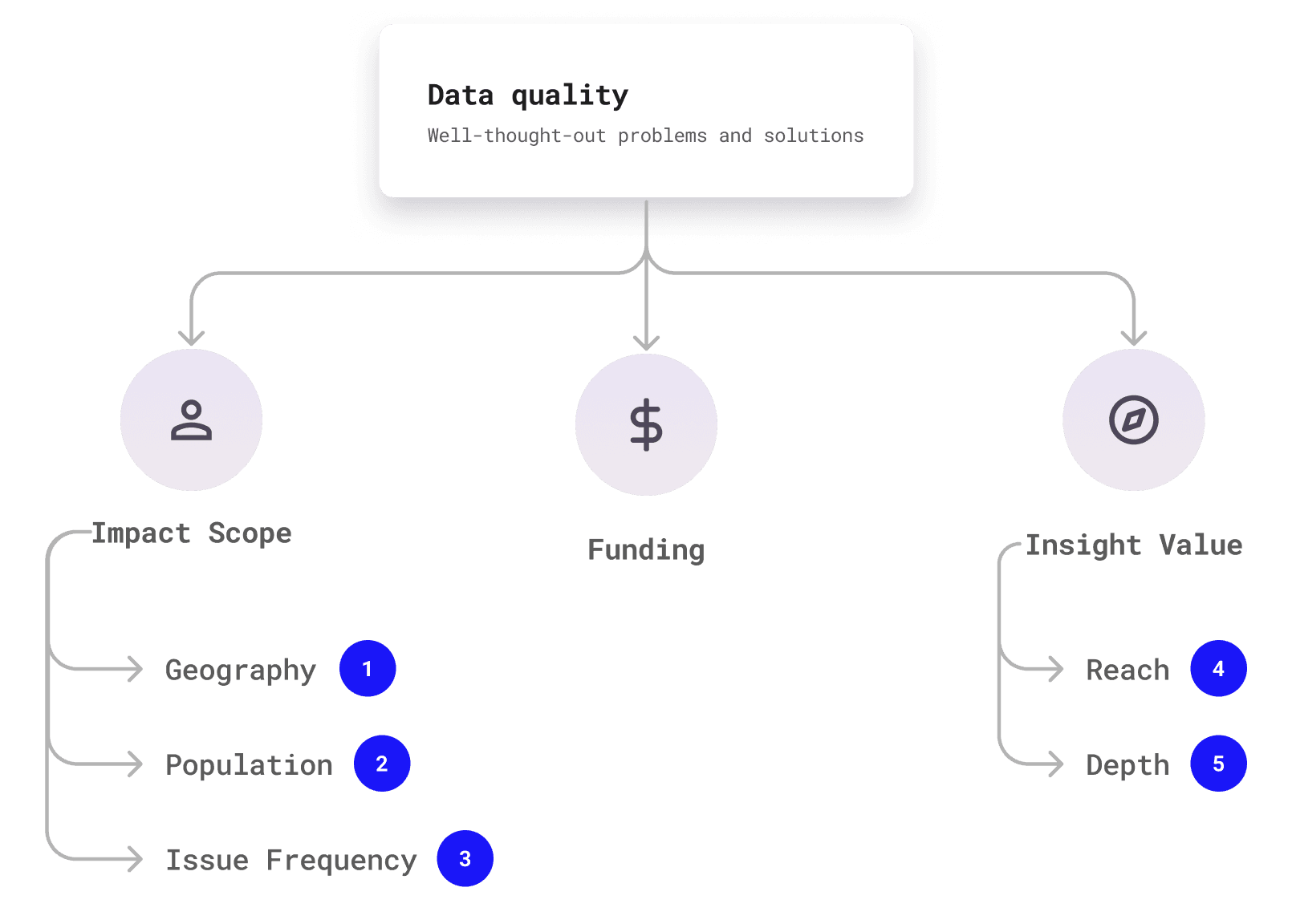
The metadata model underlying every result card
I designed a result card system that: - Exposed a few key metadata points (e.g., source type, recency, level of adoption) in a consistent visual pattern. - Used layout, color, and hierarchy to highlight credibility without requiring users to read full abstracts or descriptions. - Triggered a “refine search” state when we detected negative signals (e.g., users consistently skipping a certain type of result), both improving their experience and feeding back into our ranking logic over time.
Search results designed to communicate credibility instantly
On top of that, I triggered a “refine search” state when we detected negative signals (e.g., users consistently skipping a certain type of result), both improving their experience and feeding back into our ranking logic over time.
A "Refine Search" state that appeared when users showed signs of frustration
The goal was simple: help users quickly separate signal from noise, and build trust that the platform understood what “quality” meant in this context.
Lowering the barrier to creation: “Create” vs. “Edit”
For X4Impact to be useful, nonprofits and tech providers needed to actively contribute challenges and solutions. The problem: a well‑written challenge is hard work. It requires clarity on the problem, context, constraints, and desired outcomes, not something most people can dash off between meetings.
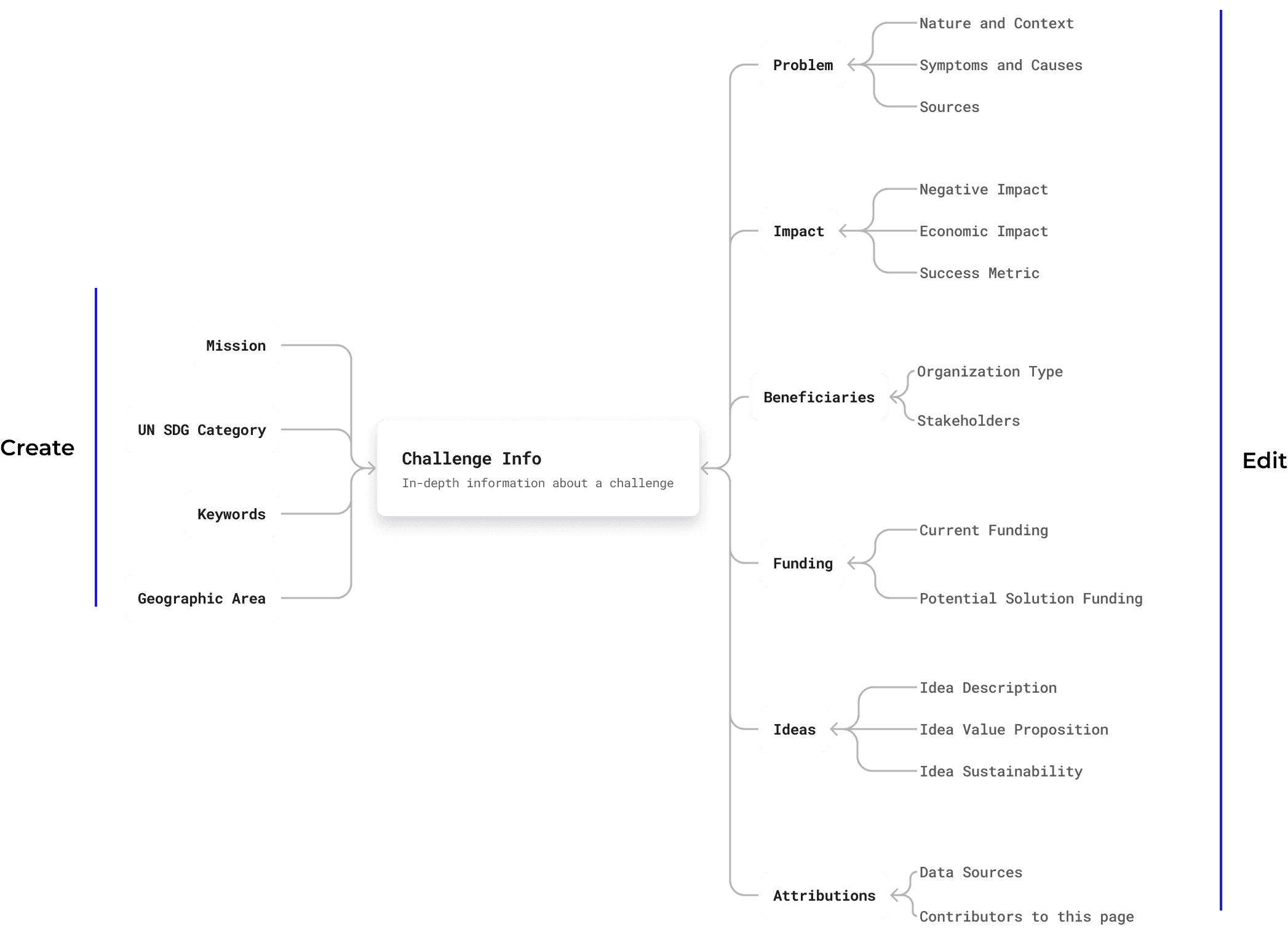
Two intentional tiers instead of one long form
Instead of treating creation as a single long form, I split it into two intentional tiers: - Create: a lightweight, mobile‑friendly flow to capture the basics — what the challenge or solution is, who it’s for, and why it matters. - Edit: a deeper, desktop‑oriented flow for refining and enriching entries with data, documentation, and references.
A short, focused form that's designed to feel completable in a few minutes
By naming and designing these tiers differently, we made it clear that “Create” is about getting something into the system quickly, while “Edit” is about making it robust over time. This shift reduced the intimidation factor and aligned with real user behavior: start small, then improve when there’s time or urgency.
Making funding visible: the money flow dashboard
A recurring frustration in interviews was how opaque funding flows are: - Nonprofits struggle to find funders aligned with their mission. - Foundations want to see where money is already concentrated, and where it’s missing. - Tech startups want to understand where investment is going across issue areas.
The Money Flow dashboard built on 10 years of public funding data
We ingested 10 years of public funding data and designed a dashboard that visualized: - How money moves across social issues and geographies. - Which organizations and solutions are attracting support. - Where gaps exist that might represent opportunities. The design challenge here was focus: turning dense data into a small number of meaningful views so users could answer questions like “Who funds tech in climate resilience?” without becoming data analysts.
Reflections
X4Impact was a messy, ambitious product: multiple user groups, multiple problems, and a lot of pressure to “solve everything at once.” It was easy for the team (myself included) to get pulled into edge cases and nice‑to‑have features. One of the most useful techniques I developed was consistently bringing the team back to primary use cases: - The platform’s main job is to help people explore, understand, and compare social impact solutions. - Creation is crucial, but secondary. We needed to avoid letting creation complexity undermine the core discovery experience. By explicitly de‑prioritizing secondary flows and anchoring discussions in concrete user journeys, we were able to keep the product shaping around what mattered most: making social impact data discoverable, trustworthy, and actionable across sectors.
Acknowledgments Most of the heavy lifting on the backend, especially around knowledge graphs and data ingestion which was done by Dr. Ying Li and the AI4PI Fellowship researchers. My focus was turning that power into an experience real people could navigate and trust.